
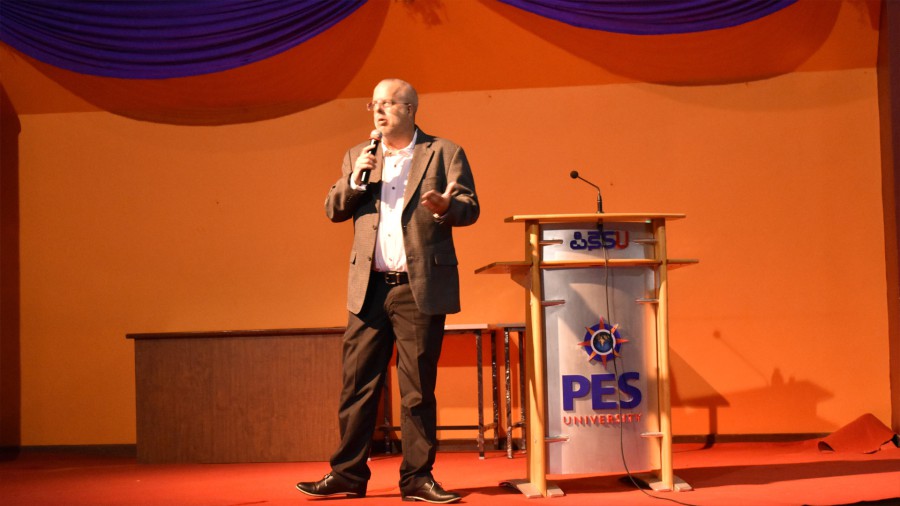
It was a great pleasure for PES University students, and faculty members to have Prof/Dr. Derick.H. Lindquist on our campus on August 11, 2022, to address the topic “Stress management at the workplace”. Dr. Derick. H. Lindquist is a professor, Dean of the Jindal School of Psychology and Counselling. He served as a postdoctoral fellowship and research associate at Indiana University and the University of Kansas. He was an assistant professor in the Psychology department at the Ohio State University in 2009. He joined OP Jindal Global University as an associate professor in 2019 and was elevated to professor and Voice Dean of the Jindal School of Psychology and Counselling. He has published more than 25 research review articles and book chapters and is a member of various organizations. He has a passion for teaching and mentoring students.
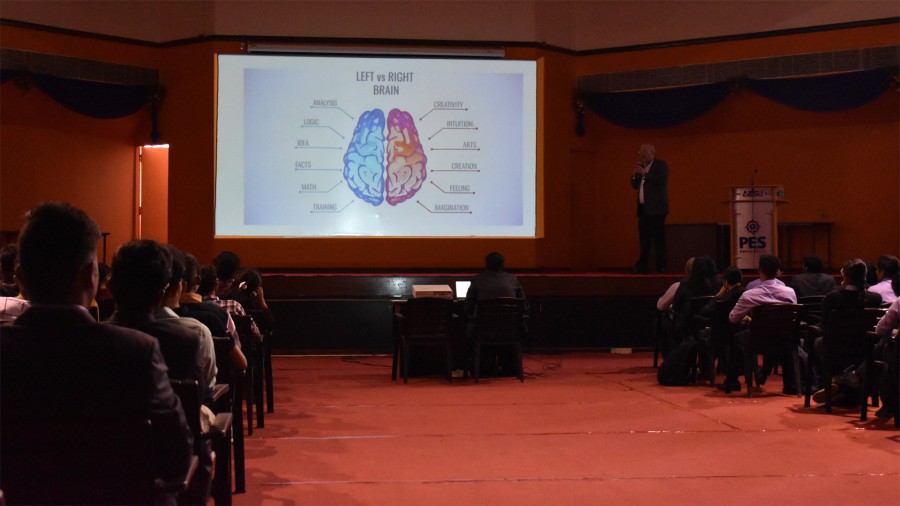
Dr. Derick. H. Lindquist started his session by explaining how the brain works. He also explained about the left hemisphere and right hemisphere of the brain which handle reading, writing, and calculations. Some call it the logical side of the brain, the right brain is more visual and deals in images more than words. It processes information in an intuitive and simultaneous manner is what he said.
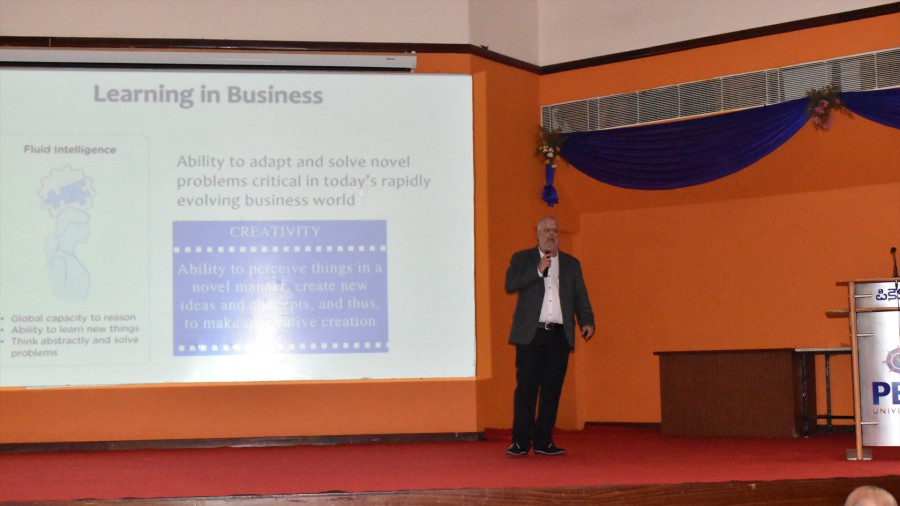
He stated that Fluid intelligence is defined as reasoning ability, and the ability to generate, transform and manipulate different types of novel information in real-time which will increase the ability to perceive things. He mentioned the 5 key domains and they are the SCARF model.
They are as follows:
• Status
• Certainty
• Autonomy
• Relatedness
• Fairness
He further explained the concept of Stress, it is a feeling of emotional or physical tension & it can come from any event or thought that makes you feel frustrated, angry, or nervous.
Feeling of being overwhelmed or unable to cop up due to external or internal demand leads to emotional, physical, and psychological strain.
He said that our bodies are uniquely designed to handle stress. When presented with a threatening situation our most basic survival instinct is to prepare to fight or run away. Stress reactions assist your body with acclimating to new circumstances.
Stress can be positive, keeping us ready, propelled, and prepared to stay away from risk. He gave an instance where, in the event that you have a significant test coming up, a pressure reaction could assist your body with working harder and remaining conscious longer. In any case, stress turns into an issue when stressors go on without help or times of unwinding.
Students were educated on the particular topic Amygdala & stress by Dr. Derick. H. Lindquist. He says too much amygdala activation, inducing chronic emotional arousal or stress, can inhibit the prefrontal cortex and high-order cognitive abilities.
He further stated about Resilience it is an ability to bounce back with a positive capacity to cope with acute and chronic distress and innate resistance to negative events examples are hardness, resourcefulness, etc.
Whereas coping is an ability to manage stress and also and ability to think rationally and solve problems, it requires conscious effort and the skill acquired through personal experience or learning is called coping.
Whereas the author says that attitude is all about thinking and feeling good about yourself, maintaining a positive attitude, spending time with people you like and admire as it will rub off on you also, keeping your eyes on the prize & Avoid date day distractions & finally Minimize Self-critique to maintain expectations.
Speaker says that the physical coping technique is diet and sleep as a well-balanced diet provides mental energy and clarity of thought. Sleep deprivation impacts physical and mental health. Keywords, stress, emotion, emotion, mental health.
.jpg)