




When Indian Space Research Organisation (Isro) launched a fllock of 104-satellites in a single launch in 2017, buried in the flood of congratulatory messages, were some concerns over adding to the junk orbiting the earth.
As space agencies across the world put their heads together to come up with a workable solution to manage space debris, a team of students from PES University, Bengaluru are planning to demonstrate a technology where a dead nano satellite or a micro satellite disintegrates into thin air.
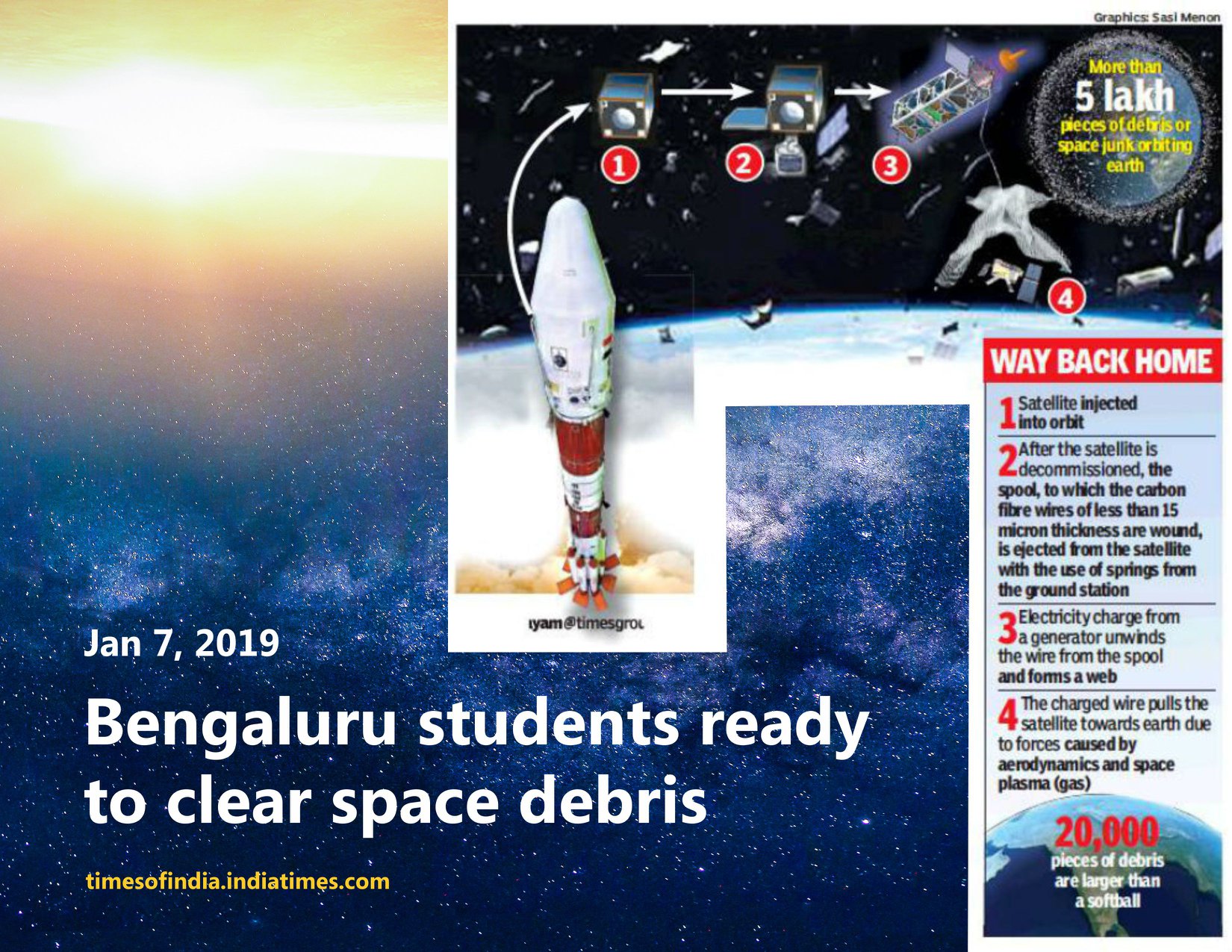
The technology involves a spool of carbon fibre wires measuring less than 15 microns in thickness (one micron = one thousandth of a millimetre) ballooning out into a spider web-like structure and pulling away a dead satellite from its orbit before sending it towards earth. The debris will disintegrate as it enters the earth's atmosphere due to the heat generated by friction. The entire process of triggering the wires, installed in a satellite, and creating favourable conditions for dragging the object can be done by activating an in-built generator to produce electric charges, the students said.
"It takes about 60 to 70 years for a satellite in low earth orbit to de-orbit and disintegrate on its own. Our simulations have showed that with our system, it will take around 5.5 years or even lesser than that," said Sharan Asundi, a professor at Tuskegee University, who is guiding the students. "The same system can be used to remove the upper stage of a rocket." Students of team Aranea displayed their work at IIT-M's tech fest Shaastra, which concluded on Sunday.
They are also preparing to demonstrate the technology 'Ultra-Thin Wires Drag Enhancement System' in PES University's second student satellite PiSat-2 likely to be launched by Isro.
Apart from the spool of wires, the system has a generator for supply of power up to 10kv to create repulsion from electric charges and trigger the wires to form a web. Asundi, who is a visiting researcher at NASA Goddard Space Flight Centre, said the system has been designed to exploit the forces created by charged wires and its interaction with space plasma.
"The more the number of wires, the better the drag. The area the web of wires may occupy, the number of wires, the mass and the volume of the system will depend on the size of the satellite. We have to ensure we don't add unwanted weight," said Shrikanta Aradhya, a student member of the team.
Nasa tracks more than 21,000 pieces of debris orbiting the earth. In June 2018, RemoveDebris satellite was deployed from the International Space Station to demonstrate three different technologies that can capture and de-orbit space junk. Space agencies have systems in place to monitor, catalogue and send alerts about approaching debris which can pose a threat to rocket launches.
"As of now space agencies are independently doing research. Discussions are on for a collaboration. As of now we are trying to avoid debris," said retired Isro scientist and Chandrayaan-1 project director Mylsamy Annadurai.
External Resource
Original article by Times of India